Zapier or Make vs MCP: which one for your AI assistant?
In short
Zapier and Make automate fixed workflows, MCP lets an assistant use tools in conversation. What each does, what Zapier MCP and Make MCP cost, and when to combine.
By FezolaPublished 3 min read
On this page
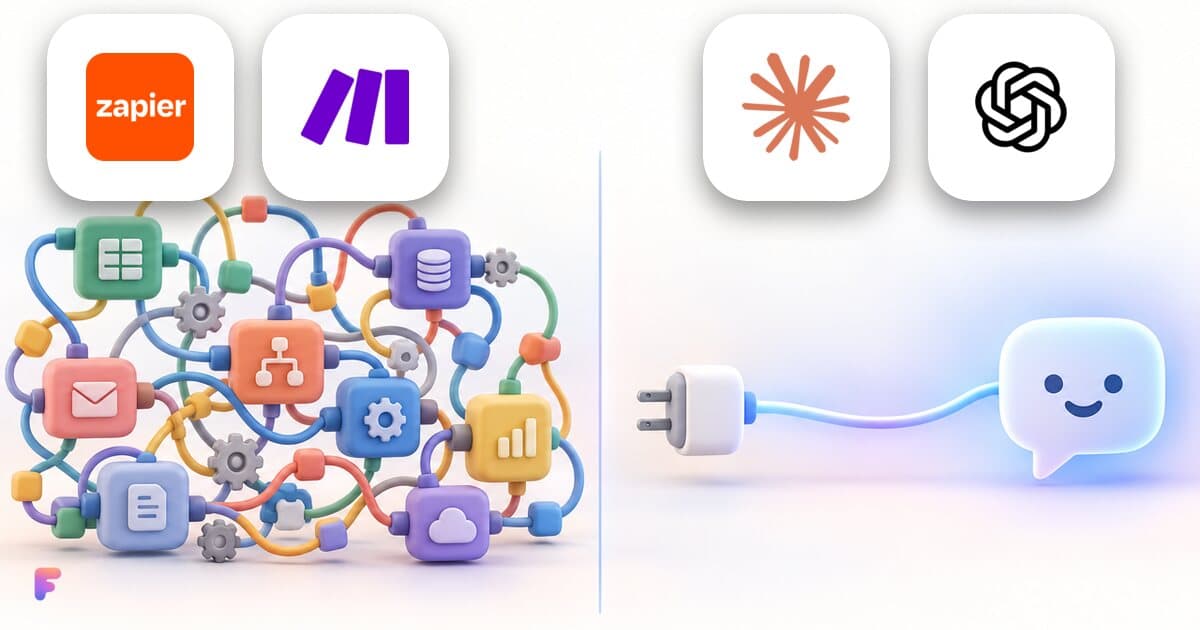
Short answer: Zapier and Make run workflows you set up in advance and keep running without you. MCP lets an AI assistant such as Claude or ChatGPT use a tool while you talk to it. Use Zapier or Make for steps that must run on their own, MCP for work you steer in conversation, and both when you need each. Facts about Zapier and Make below come from their official pages, read on 14 November 2026.
Two different jobs
An automation platform (Zapier, Make) connects apps with rules you design: when a form arrives, add a row, then send a message. You build it once, and it runs on its own, every time. Its strength is repeatability.
MCP (the Model Context Protocol, explained in what is MCP) is a standard way for an AI assistant to use tools. You ask in plain language, the assistant picks the tool, and you stay in the loop. Its strength is flexibility: you do not design anything in advance.
What Zapier MCP does
According to Zapier's MCP page, read on 14 November 2026, Zapier MCP connects AI clients such as Claude, ChatGPT and Cursor to the apps in Zapier's catalog, so the assistant can search for and run actions. Zapier advertised more than 9,000 apps and more than 66,000 triggers and actions that day.
On pricing, the page said MCP is included in all Zapier plans, and that each tool call uses 2 tasks from your quota. It also said Next Gen Zaps are free in early access until 1 December 2026, when billing starts. Zapier says it manages credentials and keeps a history of actions, and announced SOC 2 Type II compliance. Check the page for current terms.
What Make MCP does
Make's developer page, read the same day, describes a hosted MCP server: no local option is described. It can run scenarios and, on paid plans, view and edit scenarios, connections, webhooks, data stores and teams. You connect with OAuth, or with an API key. Make names Claude, ChatGPT and Claude Code as clients.
It documents time limits: an execution call times out after 25 seconds with OAuth or 40 seconds with an API key, while the scenario itself can keep running for up to 40 minutes. A scenario that takes longer does not fail, but your assistant gets an answer before it finishes.
Where a mailbox connector fits
Zapier and Make are strong when the task is a fixed chain across many apps. A mailbox connector is for something else: reading, searching and answering your mail, calendars and chats from a conversation, across several accounts.
Fezola is one: a hosted MCP connector for Gmail, iCloud, any IMAP mailbox, Outlook.com, Google Calendar, Google Chat and Telegram, plus relayed tools such as Notion and Cloudflare and a shared Memory. Replies are created as drafts by default, so you read and send yourself. It is free for 2 sources; Pro is unlimited for $9 a month or $90 a year, with a 7-day free trial.
How to choose
- A task that repeats on a trigger (a form arrives, a payment lands): Zapier or Make.
- A question or a draft you steer ("what did the client reply, and draft an answer"): a connector over MCP.
- Reading mail across several accounts: a mailbox connector, see multiple Gmail accounts.
- Both: let the assistant read and decide through a connector, and hand the repetitive step to a Zapier or Make workflow, through their own MCP servers or a trigger.
If you only want the assistant to reach many apps, Zapier MCP and Make MCP are legitimate routes, and they are billed under their own plans. If your need is mail, calendar and chat, a connector built for them usually involves less setup. On ChatGPT, adding a custom connector depends on your plan: see add an MCP server to ChatGPT.
Create your free Fezola account to connect your mailboxes.
Questions and answers
Is MCP a replacement for Zapier or Make?
No. Zapier and Make run workflows you design, on a trigger, and keep running without you. MCP lets an assistant use a tool while you talk to it. They answer different needs, and both Zapier and Make now offer an MCP server, so you can use them together.
What does Zapier MCP cost?
On its page read on 14 November 2026, Zapier said MCP is included in all Zapier plans and that each tool call uses 2 tasks from your quota. Check Zapier's pricing page before relying on it, as plans change.
Can Claude or ChatGPT run my Make scenarios?
Make offers a hosted MCP server that can run scenarios, and manage scenarios, connections and webhooks on paid plans, according to its developer page read on 14 November 2026. Claude and ChatGPT are among the clients it names.
When should I use a mailbox MCP connector instead?
When the job is reading, searching and drafting replies in your mail, calendar or chats, across several accounts. A connector such as Fezola is built for that, creates drafts by default, and does not need a workflow.
Can I use both?
Yes. A common split is a connector for what you read and decide in conversation, and Zapier or Make for steps that must run on their own, such as copying a row when a form arrives.
More in MCP basics

ChatGPT connectors and apps: what exists, how to add a custom MCP server, which plans
ChatGPT connects to tools through apps in Settings, Plugins, and, on Business, Enterprise and Edu, custom MCP servers. What exists, how to add one, which plans.
2 min read

Which Claude and ChatGPT plan do you need for custom connectors and MCP servers?
Claude allows custom connectors on Free (one), Pro, Max, Ultra, Team and Enterprise. ChatGPT on Business, Enterprise and Edu, Pro read-only. Checked Nov 2026.
2 min read

Claude connectors: what they are, how to add one, which plans, the best ones
Claude connectors link Claude to outside tools: built-in ones such as Gmail, and custom ones for any remote MCP server, added from Customize, Connectors.
2 min read