MCP vs API: what is the difference, and when do you need which?
In short
An API connects software to software; MCP lets an AI assistant discover and use tools built on APIs. A plain comparison table, when each fits, and how Fezola uses both.
By FezolaPublished 2 min read
On this page
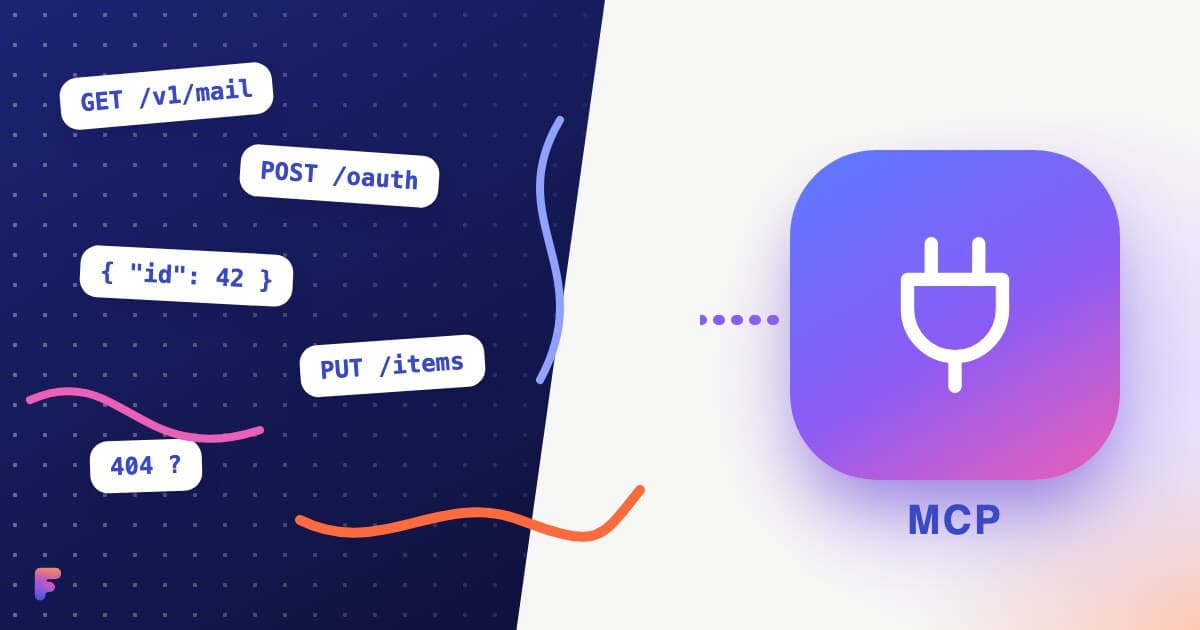
An API lets one piece of software talk to another; MCP (Model Context Protocol) lets an AI assistant discover and use tools that are usually built on top of those APIs. MCP does not replace APIs. It standardizes how an assistant such as Claude or ChatGPT finds what a service can do and calls it, so nobody writes custom glue code for every assistant and every service.
The difference in a table
| API | MCP | |
|---|---|---|
| Who uses it | Code written by a developer | An AI assistant, on your behalf |
| How it is discovered | Developers read documentation and write the integration ahead of time | The server lists its tools at runtime and the assistant picks one |
| Who decides the steps | The program, in a fixed order | The assistant, from your request |
| Standardization | Each service has its own format and sign-in | One protocol for every server |
| Best for | Predictable automation and bulk data jobs | Open-ended requests across several services |
When to use an API
Use the API directly when no language model is involved, the sequence of steps is known, and you need speed or volume: syncing records, nightly exports, a backend calling a payment service. This is what tools like Zapier and Make automate, and it stays the right tool for fixed workflows.
When to use MCP
Use MCP when you want an assistant to answer a question such as "which of my campaigns spent money without a conversion this week?" and let it choose the tools. New to the idea? Start with what MCP is.
They work together
An MCP server typically wraps an API: when the assistant picks a tool such as "search issues", the server turns that into ordinary API requests behind the scenes. Many MCP servers are therefore thin, curated layers on existing APIs, and where they run (on your machine or hosted by someone) is a separate choice: see remote vs local MCP servers.
How Fezola fits
Fezola is a hosted MCP server in front of many services. You add Fezola once at https://api.fezola.com/mcp (how to add a custom connector to Claude), connect your accounts, and the assistant discovers the right tools: Google Ads goes through Google's official API, and services such as GitHub or PostHog go through their official MCP servers, relayed by Fezola. ChatGPT custom connectors are available on Business, Enterprise and Edu plans (Pro read-only).
Safeguards matter more with MCP
Because the assistant chooses the call, keep approvals on for anything that changes data, treat text returned by a service as data and not as instructions, and connect only the accounts a task needs. You can hide a service from an assistant in Fezola: see choose which tools Claude or ChatGPT can see.
Questions and answers
Does MCP replace APIs?
No. An MCP server usually sits in front of an existing API and translates what an AI assistant asks for into ordinary API calls. The API stays; MCP adds a standard way for an assistant to discover and call it.
Should I use MCP or an API?
If no AI model is involved and you know the exact steps, call the API directly: it is simpler and faster. If an assistant such as Claude or ChatGPT must choose among tools to answer open-ended requests, use MCP.
Do I need to write code to use MCP?
Not to use one. With a hosted MCP server such as Fezola you add a single URL as a connector in Claude or ChatGPT and approve access to your accounts. Writing code is for building a server.
Is MCP less secure than an API?
It is a different risk, not a smaller one. The assistant decides which tool to call, so approvals for actions that change things matter, and text the tools return should be treated as data and never as instructions. Keep approval prompts on and give access only to what a task needs.
How does Fezola relate to APIs and MCP?
Fezola is one hosted MCP server in front of many services. It reaches mail, calendar and chat through their providers' protocols and APIs, and relays other services' official MCP servers, so your assistant needs one connector instead of one per service.
More in MCP basics

Best MCP (Model Context Protocol) servers for Claude and ChatGPT in 2026, by job
The best Model Context Protocol (MCP) servers match a job you do weekly and let you control access: email, calendar, notes, ads, SEO, social media, voice.
2 min read
Best email MCP servers for Claude (and ChatGPT Business) in November 2026
The best email MCP server depends on your setup: built-in for one Gmail, self-hosted for control, hosted like Fezola for several mailboxes. Checked 15 Nov 2026.
9 min read

Which Claude and ChatGPT plan do you need for custom connectors and MCP servers?
Claude allows custom connectors on Free (one), Pro, Max, Ultra, Team and Enterprise. ChatGPT on Business, Enterprise and Edu, Pro read-only. Checked Nov 2026.
2 min read